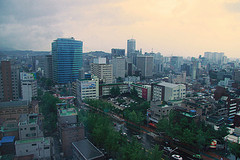
Wednesday, January 1, 2014

Planning for Sustainability: A New Year's Resolution

As the world exceeds 7 million inhabitants, global warming nears its tipping point and a majority of the earth’s citizens live in urban areas, visionary and action-oriented planning matters more than ever.

Planning is the process by which we create a vision of the future, research existing challenges, communicate with stakeholders, create and test solutions and (with politics and funding aligned) implement those solutions, evaluate the results and repeat. Without plans, society lacks the tools to make and enforce decisions that promote the collective good.

Planning matters greatly when the issue at hand will impact the entire world’s inhabitants, but can’t necessarily be felt at the present moment. The important buzzword here is environmental sustainability. A hospitable environment is the most basic requirement for human survival—it impacts people from all races, incomes, genders and nationalities (although members of minority or lower-income groups, women and certain countries often experience environmental degradation more acutely).

Planning can be incredibly effective in promoting sustainability. Sweden’s waste-to-energy and recycling plans were so successful that they have run out of garbage, and are now paid by European countries to import trash. Lancaster, California planned to become a renewable energy capital, requiring almost all new homes to be built with solar panels. The city will now receive at least 126 megawatts from solar energy.

Failing to develop and implement plans for environmental sustainability will mean an unequal, diminished quality of life for future generations. For example, global warming has caused a rise in sea levels that threatens to swallow low-lying land. This reality is forcing the island country of Kiribati to relocate entirely.

Preserving the future of life on earth is not an easy task, and communities must come together to determine the ways in which they must contribute to this shared endeavor. Such planning involves making sacrifices and reaping rewards as equitably as possible among the global citizenship. We must dedicate (or rededicate) ourselves to this work in 2014. 

Monday, April 22, 2013

Rewarding Innovation: A Sample of Great Ideas from Around the Globe


One of the most interesting and inspiring aspects of urban planning is the act of discovering innovative solutions that cities around the world are implementing to solve commonly held urban problems. The innovations might involve cutting-edge technology, or they might be a re-commitment to an age-old principle. Solutions might be driven by community volunteers, business entrepreneurs, mayors and even heads of State.

In advance of this year’s Financial Times and Citibank Ingenuity Awards, I had the opportunity to revisit some of the creative, exciting, and inspiring examples of recent innovation that could be replicated in cities around the world to provide a more sustainable, livable future for us all. I’d like to share some of them with you here. I encourage you to nominate projects you feel are deserving of recognition and support for the 2013 FT/Citi Ingenuity Awards (the deadline for 2013 nominations is April 30th).

Transportation Alternatives: People around the world have a shared understanding of the effects that conventional fossil-fueled vehicles are having on our environment and well-being. Providing effective alternatives, however, is a great challenge that is absolutely necessary in order to expect a shift in transportation habits. Here are a few projects that are tipping the scales towards sustainable, people-powered modes of transportation.

Towards Equal Infrastructure for Bikes: In April 2012, the first leg of a 26-route bicycle superhighway opened in Copenhagen, Denmark. Wanting to promote bicycling along these routes as a serious alternative to taking the train, bus or car, Copenhagen worked with 21 other municipalities to create "contiguous, standardized bike routes into the capital across distances of up to 14 miles." The bike highways are designed with clever features such as traffic lights that are timed to suit the travel patterns of cyclists during rush hour, garbage cans tilted at the right angle for bikers and solar-powered lights to enhance the cycling experience and reduce environmental impact. In response to the new infrastructure, innovative local initiatives such as a “bicycle school bus” for children commuting to class together have been developed.

Cardboard Bike for All: In Israel, Izar Gafni has produced the prototype for a bicycle whose frame and wheels are made entirely from cardboard and reused rubber. This bicycle is durable, lightweight, made from recycled materials, and importantly, is very inexpensive to produce. A bicycle that can be sold for $20 or less could go a long way towards equipping communities all over the world with the benefits of human-petaled transport. His next projects include a children's bike and wheelchair made from cardboard.

Sanitation: The concentration of people in urban areas necessitates effective and hygienic waste management. In many cities, however, people don’t have access to some of the most basic human needs: clean water, electricity and toilets. 

Build a Better Toilet: The Bill & Melinda Gates Foundation, dedicated to achieving universal access to sustainable sanitation services, recently put out a call for the best and brightest minds to design a low-cost toilet that doesn't require piped water, a connected sewer, or electricity and that transforms waste into usable materials. The California Institute of Technology won first prize in August 2012 for a solar-powered toilet that generates hydrogen and electricity. The April 2013 TED talk by Rose George underscores why finding solutions to the lack of basic sanitation is so vital and urgent.

Smaller Flush, Better Public Access: For cities whose residents already have access to indoor plumbing, a priority should be on systematic, large-scale water conservation: for an example of progress, see the pilot program in Queens, New York that has retrofit all toilets at two public schools. The program has cut water consumption by 70% and will save 700 million gallons of water per year. Access to public toilets, already commonplace in cities like Melbourne, Australia, are another important step towards urban livability—the Australian Government even has a website dedicated to finding and using public toilets! 

Solar Alternatives: Powering lights, homes and cars, renewable energy is being harnessed in innovative ways to reduce our dependence on fossil fuels. Some cities are leading the way, particularly in the area of solar energy. 

City Powered by the Sun: R. Rex Parris, the Republican Mayor of Lancaster, California announced two years ago that his city would become the “solar capital of the universe” by producing more electricity from the sun’s rays than it consumes. Lancaster is well on its way, in part by requiring new homes to either be “equipped with solar panels or be in subdivisions that produce one kilowatt of solar energy per house.” It is estimated that the city tripled the number of residential installations in the past 18 months. This progress in the residential sector combined with outfitting government and school buildings with solar panels has resulted in 39 megawatts already being generated and the 50 megawatts currently under construction (out of a necessary 126 megawatts).  

Clean Energy Economy: South Korea is also leading the pack in terms of its cities promoting and implementing renewable energy, including photovoltaic. Intending to be among the top 5 clean energy economies, the Republic of Korea is investing 40 trillion Won to develop sources of clean and renewable energy before 2015. My city of Daegu is home to an innovative concentrating solar heat tower, the first of its kind in Korea. This is how it works: 200 angled reflecting mirrors concentrate sunlight towards the top of the 60-meter tall tower. The tower’s receiver then reaches temperatures of 700-1000 degrees Celsius, which generates 200 megawatts of electricity. 

Data and Technology: In today's information age, we often have access to massive amounts of data without the means to adequately analyze what we have gathered. The following initiatives help to make good use of the information we have in order to promote the best possible actions and outcomes in our communities.

Using Technology for Management: City officials and residents need the ability to analyze data about their environment into actionable information--in real time. As Eduard Paes, Mayor of Rio de Janiero stated as one of his 4 commandments of cities, “A city of the future has to use technology to be present.” That’s why he created a command center for Rio that integrated the data and operations management of all major city functions into a single control room.

Harnessing Data for Social Benefit: Community or participatory mapping has emerged as a terrific way to put maps and data into the hands of individuals working to identify assets or challenges faced in their neighborhood. Excellent example of community mapping include the Center for Community Mapping and the youth mapping program IMSOCIO, both founded by Dr. Wansoo Im, President of VERTICES.  Some of their projects include a Safe Routes to School mapping event where high school students assessed and mapped the safety and pollution levels of sidewalks and crosswalks in Somerset, NJ, and an interactive gas station map where IMSOCIO students mapped the availability of gas at local gas stations immediately following the devastation of Hurricane Sandy.

Culling the Data: In New York City, Mayor Bloomberg has created a small "geek squad" to find precious needles in the haystacks of big data at the new Office of Policy and Strategic Planning. By strategically analyzing data to answer a question such as "which restaurants are illegally dumping cooking oil into the City's sewers," members of the Office were able to achieve a 95% accuracy rate on a list of likely culprits. Used in this way, data can help cities be more efficient and effective.

The list of innovative and timely solutions to our city's challenges grows longer by the day. I'm grateful that awards programs such as the FT/Citi Ingenuity Awards give us an opportunity to think about all of the positive work being done around us, and urge us to keep sharing, thinking, working and implementing together.

Thursday, February 21, 2013

Putting the “Rapid” into Bus Transit: Evaluating BRT in cities around the world


It has been a long-acknowledged fact that cities need to improve their public transit systems, both to improve the mobility of their residents and to move away from the greenhouse gas-emitting automobile centric planning of the 20th century. With many cities struggling to see how expensive and intensive transit projects such as subways and light rail can be implemented without the necessary funds in government coffers, existing modes of transit such as the bus have to be significantly improved upon in order to allow for rapid implementation and flexibility without the price tag.

Bus Rapid Transit (BRT) is an example of a re-designed transportation method that has achieved a lot of positive press lately. However positive some BRT developments have been, others have not realized some of the basic principles of an effective BRT and have left riders disillusioned with the concept. As Bill Gates recently urged in his 2013 Annual Letter, measuring and assessing our work to improve cities is crucial to invention. A number of cities and organizations have done just that, and their recently released assessments of bus rapid transit systems point to areas of excellence and places where there is room to improve.

Bus Rapid Transit corridor in Guangzhou, China. Credit: ITDP
Bus Rapid Transit, according to the National Bus Rapid Transit Institute (NBRTI), is defined as “an integrated bus-based “rapid” transit system typically utilizing highly-flexible service and advanced technologies to improve customer convenience and reduce delays.” It aims to be a less expensive and more flexible alternative to “LRT” or Light Rail Transit.

Several characteristics of BRT systems set them apart from traditional bus transit. First, BRT systems often have dedicated lanes and the ability to skip to the front of the line when waiting at red lights. Their main arteries function as “trunk” lines, with a number of bus routes traveling along popular routes and sometimes meeting up with “feeder” buses that travel local routes.  Its stations typically mimic subway stations in their collection of fares before entering the station, automatic doors that open when the bus has arrived and station floors that are flush with bus floors, making for easy boarding and disembarking. Intelligent transportation systems help BRT buses provide accurate scheduling information and prevent “bunching.” Finally, BRT systems are usually branded separately from local bus routes to alert the public to their faster express routes.

The first BRT system was built in Curitiba, Brazil in 1974, and became the inspiration for BRT systems in other cities around the world. Unfortunately, a number of bus systems based themselves only lightly on Curitiba’s BRT system while still utilizing the BRT name. Poor outcomes frustrated riders and tarnished the reputation of BRT systems to deliver rapid transportation at lower costs than light rail. Consequently, the establishment of new BRT systems slowed in the 80s and 90s. In 2001, Colombia’s TransMilenio BRT system opened in Bogota, and its high performance characteristics again invigorated hopes that effective BRT was possible.

BRT Rating System. Credit: ITDP
In order to avoid another series of disappointing BRT designs, the Institute for Transportation & Development Policy (ITDP) and Deutsche Gesellschaft fur Internationale Zuzammenarbeit (GIZ) have developed, tested and published a Bus Rapid Transit rating system. Similar to the U.S. Green Building Council’s Leadership in Energy and Environmental Design (LEED) rating system, the BRT rating system version 1.0, released in January 2012, awards varying numbers of points for particular features in five categories: service planning; infrastructure; station design and station-bus interface; quality of service and passenger information systems; and integration and access. In this rating system, projects can lose points for drawbacks such as low commercial speeds, low peak passenger numbers, overcrowding and poor maintenance of buses and stations. BRT systems are then awarded ratings of Gold (85-100 points), Silver (70-84 points) and Bronze (50-69 points).

ITDP has developed a number of BRT systems internationally, including recent work that I learned about while in Guangzhou, China. Opened in February, 2010, the 22.5 kilometer Guangzhou BRT features fully segregated bus lanes and serves 805,000 passengers per day and 27,000 passengers per hour carried in a single direction. This is a greater daily use than most subway systems in China, with the exception of Beijing. The Guangzhou BRT utilizes twenty six pre-pay stations that accept popular fare cards that can also be used to purchase community services, including renting shared bicycles. According to Karl Fjellstrom, of ITDP, “It’s the first BRT system in China to include bicycles in the design.  So now we have 5,000 bikes in 113 stations along the BRT corridor…[a] public bike system.  And there are also about 5,500 bike parking positions included in the BRT design.” The thirty one bus routes of the Guangzhou BRT are “direct service,” meaning that the routes also travel outside of the main BRT corridor. Passengers can arrive at their destination without being required to transfer buses, or can easily plan a multi-modal trip. Guangzhou’s BRT is the first in the world to have a direct tunnel connecting a bus station with a subway system, and four more subway lines are accessible from BRT stations. A five minute Street Film shows off the features of the BRT and how passengers have reacted to the new service.

In order to properly measure the results of the BRT in Guangzhou, ITDP released its Guangzhou, China Bus Rapid Transit Emissions Impact Analysis report in May, 2011. The report states that the Guangzhou BRT system has produced a number of positive results, including a 29% faster trip time for bus riders and 20% faster trip time for drivers in the corridor. This translates into an aggregate annual time savings of 52 million hours, and has been calculated to an economic value of 158 million yuan (over U.S. $25 million). ITDP also estimates that Guangzhou’s BRT will lead to a reduction of approximately 86,000 tons of CO₂ per year over its first ten years and about 4 tons of particulate matter emissions annually. Finally, implementation of the BRT resulted in savings for both the rider and the government. “The BRT’s total capital cost was 950 million yuan (USD 103 million), or about 30 million yuan (USD 4.5 million) per kilometer constructed. This is about one-tenth to one-twentieth of the per-kilometer cost of recent metro projects in Asia.” Additionally, the government’s subsidy has been reduced by 66% from the previous bus system, saving the government over 93 million yuan (USD 14 million) in annual operating costs. At the same time, fares were reduced by making all tickets a uniform 2 yuan (USD 0.30) rather than previous fares of between 2 and 5 yuan based on the length of the journey.

The report also highlighted four areas of improvement. First, to address overcrowding on buses and in stations, plans are in progress to upgrade 12-meter buses to 18-meter buses, increasing carrying capacity and ease of boarding. Second, the report highlights the need to reduce the number of buses in the BRT system in order to reduce traffic congestion, as there are currently more buses using the segregated BRT lanes than were originally recommended. Thirdly, most BRT stations are wheelchair inaccessible, creating a major barrier to participation for a segment of the society. Finally, the report found that “a relatively small portion of BRT riders had shifted from other motorized modes: only 1.4% of BRT riders switched from private auto, 3% from taxi, and 11% from metro (which actually has a lower emission factor than BRT).” Thus, it is important to note that the annual reduction of 86,000 tons of CO₂ came largely from converting buses from diesel to LPG, though even the small reduction in vehicle use still equates to 30,000 auto trips avoided daily because of the BRT. The expectation is that as the BRT system expands and becomes less crowded, the system will be able absorb a greater shift from automobiles to bus transit.

Other cities are also collecting and analyzing their own data regarding the effectiveness of BRT implementation. The Korea Transport Institute released a publication in 2012 that analyzed successes and shortcomings of the bus system reform in Seoul in 2004. In order to improve the traffic congestion problem, increase bus and subway ridership and discourage the use of private vehicles, the Seoul city government entirely restructured its bus system. The City redesigned its routes into trunk and feeder lines; updated its fare structure (to offer free transfers between bus-bus and bus-subway for travel of up to 10 kilometers) and smart-card payment system; introduced a semi-private operation scheme; constructed public transit centers; and implemented an exclusive median bus lane system (the number of routes with dedicated bus lanes increased from one (7.6 km) to fourteen (177.6 km). (Source: Kwang Sik Kim and Gyeong Chul Kim. Korea's Best Practices in the Transport Sector: Bus System Reform in Korea. Published 2012 by The Korea Transport Institute.)

After analyzing Seoul’s bus restructuring project, some of the following positive results were recognized:

  • Expanded spatial operation and improved reliability of bus system.
  • Increased equity in fares between subway and bus riders.
  • Integrated fare system led to an integrated public transport network of community shuttles, buses and subways. 
  • Adjusted fares reduced need for municipal subsidies.
  • The exclusive median bus lanes improved bus speeds, punctuality, and vehicular speed in morning hours, as well as reduced the number of accidents.
However, the following matters were highlighted as needing improvement:
  • Attempts to reduce the number of unprofitable lines resulted in frequent route closures or changes, thus disrupting the travel of some riders.
  • The fare system is complicated, not well integrated with the greater metropolitan area, and is excessively reliant on computerized equipment.
  • User convenience could be improved at transit centers.
  • Insufficient capacity of median bus lanes and bus stations.

Data was collected that showed that ridership in the first year after the BRT redesign rose 9%. Again, as in Guangzhou, questions arose about the extent of the shift from vehicular use to public transportation. After further analysis, KOTI determined that “the increase in bus ridership is attributable, to a considerable extent, to the growth in the number of transfers, rather than a modal shift from personal vehicles to bus.” KOTI concludes that “public transport reform alone cannot solve the traffic problems of Seoul. Therefore, it is necessary to pursue a transport demand management policy designed to rationally control the use of private vehicles as well as to implement a land use policy based on the concept of transit-oriented development.”

The lessons learned through the bus rapid transit overhaul in Seoul were recently shared at a CITYNET  and Korea Transport Institute-organized workshop in which I participated.  City planning officials from India, Sri Lanka, Indonesia, Bangladesh, Malaysia and elsewhere were invited to discuss the steps South Korea took to establish its high-class transit system, and how this knowledge could guide the planning efforts of other Asian countries. Representatives of GIZ also presented best practices from around the region.

Now that ITDP and GIZ have made significant progress in distilling the best practices of BRT, others are forging ahead with the task of popularizing this method of transportation infrastructure. In March, 2012, the Institute for Sustainable Communities released the report Accelerating Bus Rapid Transit: a Resource Guide for Local Leaders ahead of its Climate Leadership Academy. The report aims to “help local, state, regional practitioners do their jobs better by showcasing effective models and strategies for implementing Bus Rapid Transit (BRT) systems.” It cites the growing challenge to curb greenhouse gas emissions from vehicle exhaust and trends of increasing public transit ridership as primary reasons for promoting BRT in the United States. The bulk of the report is devoted to case studies of BRT planning and implementation in Cleveland, Ohio; Montgomery County, Maryland; Pittsburgh, Pennsylvania; Brisbane, Australia; Springfield and Eugene, Oregon; York, Ontario, Canada; and Chicago, Illinois.

Recent interest in and establishment of BRT systems in cities around the world is a positive development, as BRT provides a useful mechanism for increasing the speed and functionality of public transit at a lower cost than subway or light rail. However, past experience and new research has shown that not all BRT systems are perfect. There is room to improve.  Furthermore, BRT alone may not incentivize car drivers to switch to public transportation, and should be used in conjunction with other measures to discourage automobile use. Fortunately, we now have an abundance of resources to help determine the best practices and greater considerations for the successful design of future BRT systems.

Thursday, September 20, 2012

Thinking Beyond the Pale: Re-imagining Waste as Resource

In my article on collaborative consumption, I discussed a new framework of thinking that involved making use of surplus capacity in our cities: ensuring that latent opportunity for collaboration and sharing of resources made individuals better off than when they were working alone. This concept, which is taking off in so many arenas including the sharing of parking spaces, is helping us to not "waste" opportunity by maximizing the use of what already exists, rather than producing more.

Another vital paradigm that must be applied in the planning and revitalization of cities is the "cradle to cradle" or "closed loop" system. Beyond the traditional concepts of recycle and reuse, cradle to cradle aims to redirect entire streams of waste from the landfill into the raw material of another purpose or product. Or, it challenges us to create products from the beginning that will, by virtue of their design and construction, be able to be used and then reused indefinitely.

The twin loops of 'biological metabolism' and 'technical metabolism' designed by MDBC.

The first step in creating a cradle to cradle loop is to examine every component of a product and ensure that what remains of the product once it is "used" can either be recycled into a material that re-enters the production stream or biodegrade completely into nature. An example of this is the U.S. Postal Service's shipping envelopes and boxes. Every dye, glue and paper pulp that makes up the boxes and envelopes were examined from the design stage, and ingredients were chosen that reduced water and energy use throughout production and would not leave any toxic remnants behind when recycled or left to biodegrade. And what about that second "cradle" in this two-part process? According to the US Postal Service, that recycled content comes right back into their office locations, for new postal customers to purchase and use:
"We purchase more than $200 million worth of products containing recycled content each year. Many of the containers in our mail system are made from recycled materials, and so are the stamped envelopes, post cards, stamp booklet covers, and packaging materials we provide."
A closed loop system can also generate revenue while preserving the environment when a business collects a "spent" product and turns it around, for a fee, to another company that needs this as a raw material for the creation of their product. In a recent TED talk, Michael Pawlyn discusses an innovative Cardboard to Caviar program which creates a wonderful closed loop for cardboard that ends up producing caviar:
"…in their area they had a lot of shops and restaurants that were producing lots of food, cardboard and plastic waste. It was ending up in landfills. Now the really clever bit is what they did with the cardboard waste.…So they were paid to collect it from the restaurants. They then shredded the cardboard and sold it to equestrian centers as horse bedding. When that was soiled, they were paid again to collect it. They put it into worm recomposting systems, which produced a lot of worms, which they fed to Siberian sturgeon, which produced caviar, which they sold back to the restaurants. So it transformed a linear process into a closed-loop model, and it created more value in the process. Graham Wiles has continued to add more and more elements to this, turning waste streams into schemes that create value. And just as natural systems tend to increase in diversity and resilience over time, there's a real sense with this project that the number of possibilities just continue increasing."
Michael Pawlyn's talk can be viewed here:


And if turning cardboard into caviar isn't creative enough, Starbucks recently announced it is exploring the possibility of taking used coffee grounds and making bioplastics. This example of a cradle to cradle system is twice as potent because used coffee grounds, an otherwise "finished" product, could replace crops like corn in the creation of bioplastics - thus encouraging food crops to actually feed people, rather than be made into plastics. If Starbucks is able to manufacture its own disposable cups from the spent coffee grounds of its cafes, the closed loop would be immensely instructive to other businesses who may be able to achieve something similar with their waste streams.

The tightest loop can be created when the same company can reuse its spent product over and over again to create a new version of the same product. Take a look at Shaw Floors, which has designed carpets, rugs and other flooring that can be recycled into...new carpets, rugs and flooring! The impact is tremendous:
"Did you know around 3.5 billion pounds of carpet ends up in landfills each year? We're committed to reducing that amount through the Green Edge Recycling Program. Since 2007, we've already reclaimed more than 460 million pounds of carpet for recycling and reuse – and that number is growing every day."
This is how it works: a consumer purchases wall-to-wall carpeting or a floor rug. After years of use, when the consumer decides the carpet has worn out, the consumer simply contacts Shaw Floors and they'll help you arrange for it to be recycled and regenerated into new flooring by their company.

The concepts of cradle to cradle or closed loops are akin to to the recycling process, with a few important improvements. First, a priority is placed on examining the the design stage of a product - ensuring that its design and the selection of materials are such that it can be disassembled and separated for recycling or to biodegrade completely, rather than leaving bits and pieces of the product that are fated to land in a garbage heap. Think of the reduction in chemicals and hazardous materials littering the land and poisoning individuals if all products were designed from cradle to cradle. Second, these concepts focus on establishing the "plug-in," the designated after-use of the recycled product. Recycling in and of itself is good, but there needs to be demand for the recycled material. Encouraging such demand is what makes this process a loop, rather than a flat line. Finally, it is important to see these waste streams as potential revenue generators - where brokers can make capital by collecting and transporting waste, and producers can see their input costs decrease when they replace virgin material with recycled material. William McDonough and Dr. Michael Braungart, founders of Cradle to Cradle Certification and the Cradle to Cradle Products Innovation Institute, view the creation of a regenerative product loop as a way to maximize "eco-effectiveness" (maximizing opportunities) rather than "eco-efficiency" (minimizing harm).

In the urban context, one begins to see how these closed loops could weave together waste streams with energy and food production, creating multiple benefits for the city and its residents. William McDonough illustrates how his group designed a city in China to embody such an approach:
"If you flush a toilet, your feces will go to the sewage treatment plants, which are sold as assets, not liabilities. Because who wants the fertilizer factory that makes natural gas? The waters are all taken in to construct the wetlands for habitat restorations. And then it makes natural gas, which then goes back into the city to power the fuel for the cooking for the city.... And then the compost is all taken back to the roofs of the city, where we've got farming, because what we've done is lifted up the city, the landscape, into the air to -- to restore the native landscape on the roofs of the buildings. The solar power of all the factory centers and all the industrial zones with their light roofs powers the city."
William McDonough's talk can be viewed here:


In some cities we are already beginning to see waste being diverted to secondary uses. The City of Colombo, Sri Lanka has established a program in partnership with CITYNET and HELP-O whereby food waste is being generated into gas that is used to fuel the kitchen stoves of homes in the Mt. Lavinia municipality. This replaces the use of firewood or LP Gas cylinders and diverts waste. We need to create incentives for more of such thinking (and implementation) in our cities in order to slow the enormous amounts of waste being collected in our landfills.

The U.S. Green Building Council's Leadership in Energy and Environmental Design (LEED) program creates some incentives by granting points for new construction that selects products produced with a minimum percentage of recycled materials (LEED New Construction Rating System, page 54). Examples that have earned projects LEED points in this area include installing reused/reusable carpeting like Shaw's or pouring concrete comprised in part of fly ash--a waste product of coal-fired energy--or other post-consumer material. "With nearly 9 billion square feet of building space participating in the suite of rating systems and 1.6 million feet certifying per day around the world..." LEED is one helpful arena in which to promote cradle to cradle implementation, but we need more incentives to really get people thinking outside the box or beyond the pale.

If the "cradle to cradle" or "closed loop" system concept catches on in the way that the collaborative consumption concept has begun to catch on, the world's cities could begin seeing some tremendously creative ways of dealing with what is currently landfill-clogging, end-of-life waste.

Saturday, March 31, 2012

Beg, Borrow and Share: Leveraging Surplus Capacity

In an effort to create cities for the future - cities that will work for a new era of inhabitants - we can no longer employ the same prescription. A box store here, a school there, a library over there, all connected by automobile-centric roads just isn't going to cut it. These days, a growing number of people are learning to better utilize the surplus capacity present in machines, objects and even our fellow neighbors. Our cities should serve as an ideal training ground for this new wave of innovation that is bringing cost-sharing and lowered environmental impact to the needs of everyday life.

"Surplus capacity" is the difference between the maximum amount of time a machine can be used and the actual amount it is being used. Many machines or products in our lives are severely underutilized, and therefore possess a high amount of surplus capacity. We should be creative about how we can use more of this capacity, thereby reducing costs for individual households and lowering our environmental impact both at the source and at the landfill.

Consider, for a moment, your power drill. How often do you use it? According to Alex Steffen, "The average home power drill is used somewhere between six and 20 minutes in its entire lifetime depending on who you ask. And so what we do is we buy these drills that have a potential capacity of thousands of hours of drill time, use them once or twice to put a hole in the wall and let them sit. Our cities, I would put to you, are stockpiles of these surplus capacities. And while we could try and figure out new ways to use those capacities -- such as cooking or making ice sculptures or even a mafia hit -- what we probably will find is that, in fact, turning those products into services that we have access to when we want them, is a far smarter way to go." View "The Shareable Future of Cities," Alex Steffen's TED talk, here.

The solution to lowering surplus capacity in products we don't use very often, as well as keep a little more of our money in the bank rather than on our shelves, is to engage in collaborative consumption. Collaborative consumption operates on the premise that individuals or households can rent or borrow machines when they need them, rather than purchasing them new. CollaborativeConsumption.com documents the many ways we can share, barter, lend, trade, rent, gift and swap.

Rachel Botsman, co-author of "What's Mine is Yours: The Rise of Collaborative Consumption" gave an excellent TED talk about this movement. She talks us through the different arenas of redistribution markets, collaborative lifestyles and product service systems and gives many compelling examples of how collaborative consumption is occurring. View "The Case for Collaborative Consumption," Rachel Botsman's TED talk, here.

Personal vehicle ownership is one arena where collaborative consumption is making an impact. According to RelayRides (via a great infographic on futureofcarsharing.com) "the average car is used for only one hour a day," but "costs $715 a month." We are all familiar with Zipcar and other companies that have created extensive car-sharing programs. RelayRides is a new concept that allows individuals to put their cars up for rent just like zip car (but with 65% of the proceeds going to the car owner, not a corporation). Car-sharing benefits the environment: "In 2009, car sharing diminished global carbon dioxide emissions by 482,170 tons" (Frost & Sullivan).

Food also has surplus value when it is not consumed. Dumpster divers have long understood this, "harvesting" and consuming fresh and processed foods that were tossed by grocery stores for being just over their expiration date. This practice, or the practice of donating excess food to soup kitchens was often stigmatized or fraught with rules and regulations. This is beginning to change, with US Environmental Protection Agency now encouraging and giving tax incentives to businesses that donate surplus food. Other food-related sharing includes a "kitchen tool library" in Portland, Oregon that makes canning and other food preservation equipment available to local residents for week-long rental.

There's also a lighter side to "collaborative consumption." Used clothing has become a lot sexier as friends and neighbors get together for clothing swaps or "swishing parties." Lucy Shea, founder of Swishing.com and CEO of a sustainable communications firm describes swishing in this way: "Save money, save the planet, have a party: swishing effortlessly touches all of these buttons. Swishing parties are for all those women who want to combine glamour, environmental protection and frugality."

Personal skills and talents are surplus capacities as well. See an earlier article on "time banking," a practice in which people can log hours sharing their time or talents with a neighbor and redeem that earned time in a way that is most beneficial to them.

CollaborativeConsumption.com has an extensive list of initiatives that have been launched in cities and countries around the world. These collaborations are an exciting development that should be fostered and implemented on a wider scale.

###

This article was featured April 2, 2012 on the Sustainable Cities Collective site.

For more information:
How 'Collaborative Consumption' is Transforming Startups, Huffington Post

Sunday, November 20, 2011

Smart, Sustainable "Insta-Cities": A Korean Prototype

On October 31, the world’s population hit the 7 billion mark. Put another way, the earth gained one billion new inhabitants since 1999 - a mere 12 years! (Jeffrey Sachs, CNN). In an era of rapid population growth and the rapid urbanization of the world (people are moving to cities at a faster rate than to rural areas/suburban), some parts of the world find themselves needing more cities—and FAST. China, for example, is building at a staggering pace – a new city “the equivalent to Rome every few weeks” (Greg Lindsay, Departures Magazine).

So what are developers and the technology industry doing to make these new, almost “pre-fab” cities sustainable?
A rendering of harborview, songdo.com

Enter Korea’s Songdo International Business District. Built in partnership with the Korean Government, developer Gale International and Cisco Systems, this brand new city is unfurling itself on land reclaimed from the Yellow Sea. When completed (in roughly 2016), Songdo will be the size of Boston, ready for one million or more residents. Songdo will be a cutting-edge “smart city” with everything from trunk lines to lighting fixtures wired to collect data that will enable companies and residents to monitor and control virtually every piece of urban infrastructure--including water and electricity. This city is to be a prototype of a “city in a box” that will be replicated twenty times in China and India in the coming years. (Greg Lindsay, Fast Company)

Are “insta-cities” all that they’re cracked up to be? The international urban planning community has mixed feelings about the benefits of new “intelligent” cities.

Artist's rendering, Songdo.com
On the one hand, the ability to monitor utilities and infrastructure is a planner’s dream. They can get data on who is using what amount of water and when. This can help officials plan for future water needs – like using the data to determine appropriate water storage for warmer summer months, for example. Much like a home energy or water audit, residents can also analyze the current trends and create plans for reducing their use or the severity of their impact. For example, they could learn that their daily showers are expending more water than they prefer, or notice that if they wash their laundry at night during off-peak hours they can get a lower rate. The Natural Resources Defense Council (NRDC) is partnering with Opower and Facebook to create a smart phone application that will enable residents to analyze their energy usage in real-time (Katherine Tweed, Greentech Media). A wired city could have even greater impacts on our lives. According to the BBC, “Residents will have smart phones they can use to pay their bills, access medical records or just open their doors.”

On the other hand, however, some fear that the “smart city” technology could throw more wrinkles into an already complex urban system than create beneficial returns. Even Gordon Falconer, Director of Innovation at Cisco, stated in an interview that “Possible disadvantages are allowing the “smart” components to over ride everything else.” Presumably he is referring to free will or other social, economic or environmental considerations/priorities that run “counter to the meter,” so to speak. It could also make city infrastructure vulnerable to program viruses or hacking.

Some are concerned that such concentration of information in the hands of the government or, in particular, private corporations, could create a “big brother” effect. Note that during the interview, Mr. Falconer suggests that “Government should be a facilitator, policy maker and a regulator of smart cities while ICT companies and private sector developers/operators should do the actual design and construction and operation” (emphasis added). 

Kaid Benfield, Director of Sustainable Communities and Smart Growth at the Natural Resources Defense Council, cautions against a “gizmo cities” focus – where some superficial ideas like monitoring and manipulating data on underlying urban infrastructure – is misconstrued with the hard work of building holistic, truly sustainable cities (Kaid Benfield, featured on Grist Magazine).

The good news is that Songdo doesn’t seem to be the kind of “gimmicky” project that Benfield decries. The Songdo District has been designed to follow best practices in urban sustainability, and is participating in the U.S. Green Building Council’s LEED Neighborhood Design program. For starters, Songdo’s “Third party development land sale agreements will contain language mandating that buildings erected must pursue LEED Certification.” (Songdo website)

Songdo IBD by Flikr user my memory2
Emphasizing six core sustainability areas of open space, transportation, water, energy use, recycling and general operations, Songdo is shaping up to be an impressive exercise in sustainability. For example: it will preserve 40% of its area for natural open space, and the city offers a 100 acre Central Park. With 25 kilometers of bicycle paths, a subway line into Incheon, most of its parking underground and prime parking set aside for electric and low-emissions vehicles, Songdo prioritizes the right kind of transportation. The city will use efficient appliances, reclaimed stormwater, reused greywater and green roofs to minimize its water usage.

Songdo already has 35,000 residents, and progress is steady on a 68-story, 1,001-foot residential tower that will become the tallest building in Korea.

Friday, October 21, 2011

Learning from the Past: Balancing Preservation and Urbanization


...quit thinking abut decent land-use as solely an economic problem. Examine each question in terms of what is ethically and aesthetically right, as well as what is economically expedient. A thing is right when it tends to preserve the integrity, stability, and beauty of the biotic community. It is wrong when it tends otherwise....This is a plea for the preservation of some tag-ends of wilderness, as museum pieces, for the edification of those who may one day wish to see, feel, or study the origins of their cultural inheritance. (The Land Ethic from A Sand County Almanac, 1949)
Aldo Leopold - US Forest Service
Aldo Leopold, a behemoth of the conservation movement, was born in 1887.  Leopold attended Yale University's School of Forestry and joined the US Forest Service when the Service was just four years old. During his life he advocated for what would become the first designated wilderness area in the world and wrote countless books, such as the famous A Sand County Almanac, about preserving and living in ecological harmony with the land rather than using it merely as a disposable economic resource.

"...I am glad that I shall never be young without wild country to be young in" said Leopold, bemoaning the destruction of nature, however necessary it may have been for America's early settlers. In the 60 years since his death, that trend of destruction has only continued. Many of us have, in fact, grown up in an era where wilderness was only occasionally experienced during a family vacation - a camping trip or a weekend at a rented cabin.

How can we inspire a new generation to care for nature and promote open space?

Monday, August 29, 2011

Urbanization and its discontents

Don't freak out, but...we are overpopulating the world to a severe degree, and urbanization won't save us!

This is the view of Kingsley Davis, a pioneer of historical urban demography and world urbanization, in his 1965 Scientific America piece "The Urbanization of the Human Population." He explains that "urbanization" is a term that describes not merely the growth, in population, of cities--but a relative change between the urban and rural (read: farming) population. Thus, just because a city's population is growing does not mean that more people are migrating from the country into cities (urbanization).

Davis goes over the history of urbanization in Northwest Europe (urbanization began to support trade and economic production) and the "S-curve" theory of urbanization (urbanization starts off slow and then increases rapidly as economic incentives from prospering city industries continue to increase, and then tapers off as overcowding and the availability of automobiles and other conveniences encourages people to move into suburban areas).

Davis also addresses the misplaced anxiety of leaders in underdeveloped nations that a severe rural-urban migration is underway. While it is true that developing countries are becoming urbanized at a slightly faster rate than those of the 19th century (about 5%), the overall growth of their cities can't be predominantly explained by urbanization.


Greenberg, Seattle Post Intelligence, 1994
 Rather, absolute population growth via births and increased life expectancy in these countries is causing a steep increase in both urban AND rural populations. This puts countries between a rock and a hard place. Davis states that "If they do not substantially step up the exodous from rural areas, these areas will be swamped with underemployed farmers. If they do step up the exodous, cities will grow at a disasterous rate."

His final warning, or thesis statement, is stern: "It seems plain that the only way to stop urban crowding and to solve most of the urban problems besetting both the developed and underdeveloped nations is to reduce the overall rate of population growth...Urban planners continue to treat population growth as something to be planned for, not something to be itself planned."

Monday, August 22, 2011

Retrofitting "Trashed" Land into Benefical Community Space

Oasis appears
Decay now gives way to growth
Nature rejoices

-Louis J. Lombardo[1]

On a hot day last month, my husband and I happened upon a hidden oasis in Daegu, Korea: the Daegu Arboretum. We strolled through the park, which featured 230,000 square meters of gardens and greenhouses, including a cactus greenhouse, a bog garden, an herb garden and a picnic area. It was bustling with children and adults alike, all enjoying the space and their ability to connect more closely with nature.
Map of Daegu Arboretum. Photo by Jace Lee.
The arboretum, while a splendid refuge for city residents, also holds a deeper significance: the park is built on a large landfill that was in operation from 1986-1990. It was converted into civic space by city government. This project, which opened in 2002, is part of a growing trend in cities across the world.


You don’t have to go far from Daegu to see other successful landfill retrofits. Once known for its flowers and as a site to grow vegetables, the small island of Najido in the Han River near Seoul became a landfill site in the 1970s. As the repository for the trash coming from a growing city, the site quickly expanded into a mountain of trash said to be 34 times the size of the Pyramids of Giza. After the landfill was closed in 1993, the City of Seoul installed 100 methane gas extraction wells to reduce greenhouse gas emissions and help power the city. The 2002 World Cup brought renewed interest in redesigning Najido into an eco-friendly island. 2.8 million Square meters of former landfill were transformed into five differently themed parks. Today, the successful World Cup Park sees 9.8 million visitors a year. 

Saturday, June 18, 2011

Asian Green City Index Highlights Opportunities for Improvement

Seoul, by Hyunwoo Sun
Earlier this year, a major report was published by the Economist Intelligence Unit (EIU) that dug into current trends among major cities in Asia.  In the Asian Green City Index, the EIU looked at 22 Asian cities (capitals and other leading business centers) and compared them against each other in key areas of environmental performance. Each city received both an overall ranking and a breakdown of what contributed to their scores in each key area. The following data from one city, Seoul, demonstrates what the study highlights.
The report, sponsored by Siemens, concluded that Seoul ranked “above average” (receiving a score of 4 out of 5), and shares this distinction with Hong Kong, Osaka, Taipei, Tokyo and Yokohama. The city of Singapore was the only city to achieve the score of “well above average.”
Seoul, the third most densely populated city in the study, ranked well in areas of energy and carbon dioxide, transportation, water, land use and buildings, sanitation and environmental governance. Seoul was lauded for having one of the best transportation networks of buses and subways, and for having minimal water leakage problems coupled with one of the highest rates of access to sanitation and wastewater treatment. The City is also at the top of the class (compared to cities with similar income levels) for low carbon dioxide emissions and high energy efficiency.
Seoul Traffic, by JimTheGiantEagle
However, the study revealed that “[Seoul] produces the most waste among all 22 cities in the Index, at an estimated 996 kg per person per year, well above the Index average of 375 kg.” Seoul also only scored “average” on its air quality because of the amount of nitrogen dioxide emissions. “It has the second highest concentration of this pollutant in the Index, at 71 micrograms per cubic metre, compared to the average of 47 micrograms. This is due to Seoul’s over-reliance on cars — automobiles are a main source of nitrogen dioxide — and they are responsible for almost three quarters of Seoul’s air pollution.” Seoul also boasts less green space than the study’s average.
The report highlighted figures from the United Nations and the Asian Development Bank revealing that Asian cities are becoming more concentrated as people migrate to urban centers (over the last five years over 100,000 residents moved to Asian cities every day). Overall, the study sought to determine the environmental strength of these leading cities and offer areas for improvement.

Wednesday, May 18, 2011

City Spotlight: Daegu, South Korea a renewable energy innovator

A version of this article was also published in the City of Daegu's English language newspaper In Daegu.

As the demand, cost and availability of energy continues to rise, cities that invest in clean, green sources of energy are building a sustainable future for themselves and their inhabitants. Last year, South Korea announced its intention to spend 40 trillion Won to support the development of clean and renewable sources of energy between now and 2015. The Korean government wants to become one of the worlds top five clean energy economies. Such a commitment to clean energy greatly benefits many cities in Korea. Here we showcase the City of Daegu in Southeastern Korea. As the third largest city in the country with a population of 2.5 million, Daegu has already made significant strides of its own in the field of renewable and green energy technology.

Daegu promotional poster highlights its
recognition as an ISCI "solar city."

Daegu didnt just jump on the renewable energy bandwagon as soon as it became popular. Rather, the city has had a systematic approach to solar and other sustainable energy sources since the creation, in 2000, of a forward-looking 50-year project plan called Visions for a Sustainable City. Spearheaded by three Professors from Kyungpook National University, this plan aims to:

1) reduce the carbon footprint of Daegus residents
2) develop a renewable energy-based urban community
3) pursue culturally and ecologically sound economic development

Daegu joined the International Solar Cities Initiative in 2003 and, in 2004, hosted the first International Solar Cities Congress.

In April 2011, Solar City Daegu held its 4th annual Green Energy Expo at the EXCO center with international participation almost 400 companies and 40,000 attendees. The Expo showcased a number of initiatives currently underway in Daegu (including the EXCO center itself, whose renovations will produce over 1.1 million kilowatts of electricity from renewable energy sources).

Daesung Energy's model of the
solar power tower.
Lets showcase a few initiatives. In the works since 2008, Koreas first solar power tower project by Daesung Energy will deliver 200 kilowatts of energy via a solar heat concentrating system to the citys grid this fall. This solar power system will be the largest solar energy plant in Korea.

Additionally, Daegu is home to a landfill gas-to-energy facility that, since 2006, has provided the city with 1.5 megawatts of energy per hour. Designated as a UN Kyoto Protocol Clean Development Mechanism, this project prevents over 300,000 tons of carbon dioxide from being released into the atmosphere.
Fiberboard slate is manufactured
from discarded fibers pictured here.

Other exciting innovations were showcased at the Expo that should be implemented in Daegu and in other cities around the world. These include street lights that generate their own power via a small solar panel or wind turbine perched at the top of the pole and car ports fitted with solar power roofs.

Also be on the lookout for an innovative new fiber board slate, made by Hyundai Industrial Trident. While not a source of energy, this innovative process is reusing discarded fibers (trash) from the garment and textile industries in and near Daegu to create non-toxic corrugated roofing material.

Looking ahead, Daegu will be the host city of the 2013 World Energy Congress in October. Until then, the city will continue to implement new and exciting forms of clean, green energy and promote innovative ways to reuse what is otherwise considered trash.

Monday, April 11, 2011

New York by Gehry: deconstructing the tallest residential structure in the West

In February 2011, the New York by Gehry building finally opened its doors to occupants. This 76-story, 870-foot tall skyscraper in Manhattan is now the tallest residential building in the Western hemisphere. With 903 apartments, this new structure’s total occupancy is greater than some depopulated rustbelt towns.[1] A structure of such significant scale should be examined for the physical, social, economic and environmental impacts that it—and the governmental regulations that helped finance it—will have on its community.  While it will surely become an iconic addition to the skyline, New York by Gehry exhibits only the barest elements of environmental conservation and economic equality, and has therefore missed a great opportunity to become known for arguably more important contributions to New York City. This is an unfortunate consequence of both the developer’s priorities and the lack of appropriate governmental regulation.

Physical Merits: A Unique Addition to the Skyline

The New York by Gehry building (formerly called Beekman Tower and then 8 Spruce Street) is located in Manhattan’s Financial District. Designed by renowned architect Frank Gehry for developer Bruce Ratner, the structure features a façade of billowing, undulating stainless steel. Initial reviews of the building’s design have been largely favorable. Nicolai Ouroussoff, architectural critic for The New York Times calls it “the finest skyscraper to rise in New York since Eero Saarinen’s CBS building went up 46 years ago.”[2] The New Yorker’s Paul Goldberger has called it “the first big apartment house worth talking about in more than a generation.”[3]
In addition to praise, a few criticisms have also been leveled against the structural design. One is that the undulating folds, which catch the sun at different angles throughout the day, were only chosen for three sides of the building. The structure’s south side is flat, and looks to some as though the building “presents its backside” to Wall Street.[4] Others criticize the unique exterior design for not translating into the interior of the apartments.[5] Notwithstanding these minor criticisms, most agree that the building adds additional vitality and dramatic flair to lower Manhattan’s skyline.

Environmental Impact: Minimal Attention to Sustainability

Despite its forward-thinking architectural design, however, the building contains few innovative sustainable design features. Although it has implemented some environmentally sound practices such as energy-efficient windows, Energy Star appliances and a greywater filtration system, New York by Gehry is not LEED certified.[6] In fact, Frank Gehry made quite a stir last year when he stated that “a lot of LEED is given for bogus stuff” and that the costs of green building are “enormous” and “they don’t pay back in your lifetime.”[7] Gehry later clarified his views, explaining that he is, in fact, in favor of environmentally-sustainable building choices even if they are not included in LEED’s process.[8] Gehry contended, however, that the path to sustainable buildings and neighborhoods is ultimately a political one, citing his recent work in Switzerland:

They don’t use the LEED program over there, the government just says this is what you can and can’t do, and things have to be built in a sustainable way. So really it’s a political thing: People taking responsibility on an individual level combined with government programs that give mandates that say “this is how we’re going to require people to build.”[9]

If the designers of New York by Gehry had been inclined to reduce the building’s environmental impact, they could easily have taken a cue from recent residential additions in neighboring Battery Park City. Best practices in environmentally-friendly, low carbon residential high-rises are evident in buildings such as The Solaire (LEED Gold), The Visionaire (LEED Platinum) and Tribeca Green (LEED Gold).[10] The Solaire, for example, lowers energy demand by utilizing about 450 solar panels, built into the building’s façade.

These “green” buildings exist in part because the Battery Park City Authority (BPCA), charged in 1968 with redeveloping the dilapidated former Port of New York area into a mixed-use neighborhood with public space, adopted a policy in 2000 that requires developers to build environmentally sustainable apartments. Under the BPCA policy, structures in the area must address indoor air quality, water conservation and purification, energy efficiency, recycling of construction waste, the use of recycled building materials and building commissioning to enhance building performance.[11] BPCA even created a user-friendly best practices document that details the ways in which sustainable measures have been successfully integrated into neighborhood residential buildings.[12]

Economic Impacts: Public Dollars Financed Just Another Luxury High-Rise

All 903 dwellings in New York by Gehry are luxury apartments being rented at current market rates: studios start at $2,630-per-month, one-bedrooms are $3,580 and two-bedrooms $5,945.[13] Units are not for sale.

Despite being marketed only to the affluent, a substantial portion of the financing for the project came from public bonds and government tax breaks. The building was built, in part, with $203.9 million in tax-free financing from the New York Liberty Bond Program, a pool of funding administered jointly by the New York State Housing Finance Agency (HFA) and the New York City Housing and Urban Development Council (HDC) that was made available after September 11, 2001 to help rebuild lower Manhattan.[14]

Under the Liberty Bond Program, developers need only pay a three percent affordable housing fee (approximately $6 million in the case of New York by Gehry) rather than setting aside affordable units within the building itself.[15] This is a departure from the HFA’s traditional program which requires 20% of units within buildings financed with tax exempt bonds to be set aside for affordable housing.[16] 

Although the goal of rebuilding lower Manhattan is a noble one, if one were really concerned with maximizing affordable housing, the 3% fee option achieves significantly less desirable results than the traditional 20% affordable housing rule imposed by the HFA. According to HDC, it “constructed 467 affordable housing units using approximately $31.4 million in fees derived from previous Liberty Bond transactions.”[17] This equates to a cost of $67,237 per unit of affordable housing. Using these figures, the $6 million fee paid by Ratner for New York by Gehry bankrolls 89 affordable housing units outside of the building. By contrast, twenty percent of 903 units would have made 180 affordable housing units available within the building.

Additionally, although no affordable housing units were included within the building, all apartments in New York by Gehry will ironically be rent stabilized for the next 20 years.[18] Because the building was financed in part by government dollars, it was also eligible for a 421-a 20-year tax exemption (which Ratner applied for just before amended requirements came into effect in June 2008 that included compulsory on-site affordable housing requirements).[19] A requirement of properties included within the 421-a tax exemption is that the building’s units are reviewed by the Rent Guidelines Board, and generally subject only to periodic rent increases of 2-3 percent. Thus, while tenants of New York by Gehry are clearly willing and able to pay top dollar for their luxury apartments, they will enjoy modest incremental rent increases—a policy intended to keep middle and working class citizens from being priced out of their neighborhoods. Rent stabilization applied in this way seems a far cry from what the program was initially intended to accomplish. 

Spatial and Social Considerations: A Town-in-a-Building

New York by Gehry isn’t entirely residential: its lowest six floors house public facilities, including a five floor K-8 public school financed with public dollars, and one floor for the New York Downtown Hospital. [20] This type of mixed-use allocation is generally positive, as it allows for community interaction and connection. However, the New York by Gehry design seems to have deliberately minimized the opportunities for such social connections: the entrance to Public School 397 “is on the east side of the building, separated from the residents’ entrance on the west, so the streams of children arriving and lawyers and bankers leaving for work do not have to cross.”[21] Perhaps this lack of contact is the reason why the school recently had trouble with residents from the above floors carelessly dropping bottles onto the school’s playground.[22]

In addition to being segregated from the public access facilities on floors below, the building is also effectively cut off from the street.  The building was designed to exude an air of exclusivity that extends to the ground level where “residents will enter through a covered drive that cuts through the block along the building’s western side” and that is designed to “accommodate taxis and limousines ferrying people in and out of the building, making it feel more like a luxury hotel than a classic Manhattan apartment building.”[23]

This social isolation is further reinforced by the fact that the plethora of luxury amenities within the building mean that residents will seldom have to venture outside their building—or tax bracket—for socialization and recreation. Although residents likely enjoy the building’s 50-foot swimming pool, fitness center and spa, grilling terrace, game room, drawing room with grand piano, chef’s kitchen, library, “tweens den,” children’s playroom, screening room, and “comprehensive concierge and lifestyle services”—the unfortunate result may be that the need for interaction with a diverse greater community will be minimized.[24] Jane Jacobs, longtime critic of New York urban planning, would decry the lack of social interaction on street level and among those of differing backgrounds.[25]

Final Marks

In sum, New York by Gehry achieves success in some areas but misses meaningful opportunities in others. Its architectural contribution to the New York City skyline is undoubtedly significant. And it helped to bring renewed interest to previously devastated lower Manhattan. On the other hand, it reinforces the need for stricter governmental regulations regarding environmentally sustainable and economically equitable building practices. New York by Gehry’s developers took advantage of a public bond program that stipulated weak affordable housing requirements in the name of rebuilding of lower Manhattan, and rushed to finalize plans before more stringent affordable housing rules for 421-a tax abatements were implemented. They eschewed LEED and other environmental design best practices evident in nearby Battery Park. And they ultimately designed yet another socially-isolated luxury apartment. In short, rather than innovate, those involved with New York by Gehry did what many other private developers regrettably do: create the most profitable, rather than most socially beneficial structure.

We must do better. Perhaps Frank Gehry had it right: the most effective way to achieve sustainability is to mandate it. Stronger sustainable building and design standards can contribute meaningfully to the re-development of urban neighborhoods—especially in areas targeted to receive governmental assistance. If sustainable building design remains voluntary or subject to weak government regulations, opportunities for truly innovative approaches to the built environment will be missed, as they were in the case of New York by Gehry.


This essay is a modified version of an article I originally published on April 11, 2011 on renewcities.org.
[1] See Braddock, Pennsylvania, population 2,159 in the 2010 census; see also Klaw, Waverly de Bruijn. (March 6, 2011). Levi’s Jeans and Braddock, PA: another marketing tool puts the abandoned city into view. Retrieved February 2, 2013 from the Renew Cities website: http://www.renewcities.org/2011/03/levis-jeans-and-braddock-pa-another.html
[2] Ouroussoff, Nicolai. (February 9, 2011). Downtown Skyscraper for the Digital Age. Retrieved February 2, 2013, from The New York Times website: http://www.nytimes.com/2011/02/10/arts/design/10beekman.html
[3] Goldberger, Paul. (March 7, 2011). Gracious Living: Frank Gehry’s swirling apartment tower. Retrieved February 2, 2013, from The New Yorker website: http://www.newyorker.com/arts/critics/skyline/2011/03/07/110307crsk_skyline_goldberger
[4] See Ouroussoff, supra, n.2.
[5] Gardner, James. (December 1, 2010). Gehry undone: Spruce Street building billows to nowhere. Retrieved February 2, 2013, from The Real Deal website: http://therealdeal.com/issues_articles/james-gardner-gehry-undone/
[6] Kamin, Blair. (February 8, 2011). Gehry's 8 Spruce Street not pursuing LEED certification; Gang's Aqua is. Retrieved February 2, 2013, from The Chicago Tribune website: http://featuresblogs.chicagotribune.com/theskyline/2011/02/im-looking-forward-to-reviewing-frank-gehrys-new-8spruce-street-tower-in-new-york-which-is-drawing-raves-from-new-york-criti.html
[7] Kamin, Blair. (April 10, 2012). Frank Gehry holds forth on Millennium Park, the Modern Wing and why he's not into green architecture. Retrieved February 2, 2013, from The Chicago Tribune website: http://featuresblogs.chicagotribune.com/theskyline/2010/04/looking-down-on-the-stunning-view-of-the-frank-gehry-designed-pritzker-pavilion-from-the-art-institute-of-chicagos-renzo-pian.html
[8] Leonard, Abby. (June 14, 2010). Architect Frank Gehry talks LEED and the future of green building. Retrieved February 2, 2013, from the PBS  website: http://www.pbs.org/wnet/need-to-know/culture/architect-frank-gehry-talks-leed-and-the-future-of-green-building/1458/
[9] Ibid.
[10] The Solaire: 20 River Terrace, New York, NY 10282; The Visionaire: 70 Little West Street, Battery Park, NY 10004; Tribeca Green: 325 North End Avenue, New York, NY 10282.
[11] Proenza, Crystal. (September, 2007). Battery Park City: An Urban Experiment. Retrieved February 2, 2013, from The Cooperator: Co-op and Condo Monthly website: http://cooperator.com/articles/1500/1/Battery-Park-City/Page1.html
[12] Battery Park City Authority. (May, 2005). Hugh L. Carey Battery Park City Authority Residential Environmental Guidelines.  Retrieved February 2, 2013, from the BPCA website: http://www.batteryparkcity.org/pdf_n/BPCA_GreenGuidelines.pdf
[13] Chaban, Matt. (February 14, 2011). You Can Finally Rent a Piece of New York… by Gehry, That Is. Retrieved February 2, 2013, from The New York Observer website: http://observer.com/2011/02/you-can-finally-rent-a-piece-of-new-york-by-gehry-that-is/
[14] New York City Housing and Urban Development Corporation. (February 27, 2008). HDC Board Approves Financing for Two Major Projects. Retrieved February 2, 2013, from the HDC website: http://www.nychdc.com/pages/pr_02%252d27%252d20081.html
[15] New York City Housing and Urban Development Corporation. (June 7, 2010). HDC Board of Directors Approves $45 Million in Tax-Exempt Bonds For the Financing of Beekman Tower.  Retrieved February 2, 2013, from the HDC website: http://www.nychdc.com/pages/pr_6%252d7%252d20103.html; see also FC Beekman Associates, LLC. (November 22, 2010). Letter Re: Petition to submeter electricity at a building located at 8 Spruce Street, New York, NY 10038. Retrieved February 2, 2013, from the New York State Public Service Commission website: http://bit.ly/WREz2V
[16] Good Jobs New York. Liberty Bond Housing Coalition Statement. Retrieved February 2, 2013, from the Good Jobs New York website: http://goodjobsny.org/economic-development/liberty-bond-housing-coalition-statement
[17] New York City Housing and Urban Development Corporation. (April 1, 2008). HDC Closes on a 904-Unit Frank Gehry Designed Tower in Lower Manhattan. Retrieved February 2, 2013, from the Real Estate Rama: Government and Public Relations News website: http://newyork.realestaterama.com/2008/04/01/hdc-closes-on-a-904-unit-frank-gehry-designed-tower-in-lower-manhattan-ID0259.html
[18] Shapiro, Julie. (February 22, 2011). Frank Gehry's Skyscraper Has Rent-Stabilized Apartments. Retrieved February 2, 2013, from the DNA Info website: http://www.dnainfo.com/new-york/20110222/downtown/frank-gehrys-skyscraper-has-rentstabilized-apartments
[19] Shapiro, Julie. (June 27-July 3, 2008). C.B. 1 approves Ratner’s tax break just by saying no. Retrieved February 2, 2013, from the Downtown Express website: http://www.downtownexpress.com/de_269/cb1approvesratners.html; See also Wambua, Matthew. (May 21, 2012). 421-a Legislation Overview and FAQ. Retrieved February 2, 2013, from the NYC Department of Housing Preservation & Development website: http://www.nyc.gov/html/hpd/downloads/pdf/421a-FAQ.pdf
[20] Ibid.
[21] Taylor, Kate. (November 28, 2011). Living in a 76-Story Work of Art, and a Symbol of Rebirth. Retrieved February 2, 2013, from The New York Times website: http://www.nytimes.com/2011/11/29/nyregion/living-inside-new-york-by-gehry.html
[22] Ibid.
[23] See Ouroussoff, supra, n.2.
[24] See New York by Gehry official website, supra, n.6.
[25] Drier, Peter. (Summer 2006). Jane Jacobs’ Radical Legacy. Retrieved February 2, 2013, from the National Housing Institute’s Shelterforce Magazine website: http://www.nhi.org/online/issues/146/janejacobslegacy.html
_________________________________________________________________

Photos by flickr contributors Structures:NYC, emmett.hume, Alex Terzich, Atomische • Tom Giebel, jikatu and onesevenone.