Friday, October 21, 2011

Learning from the Past: Balancing Preservation and Urbanization


...quit thinking abut decent land-use as solely an economic problem. Examine each question in terms of what is ethically and aesthetically right, as well as what is economically expedient. A thing is right when it tends to preserve the integrity, stability, and beauty of the biotic community. It is wrong when it tends otherwise....This is a plea for the preservation of some tag-ends of wilderness, as museum pieces, for the edification of those who may one day wish to see, feel, or study the origins of their cultural inheritance. (The Land Ethic from A Sand County Almanac, 1949)
Aldo Leopold - US Forest Service
Aldo Leopold, a behemoth of the conservation movement, was born in 1887.  Leopold attended Yale University's School of Forestry and joined the US Forest Service when the Service was just four years old. During his life he advocated for what would become the first designated wilderness area in the world and wrote countless books, such as the famous A Sand County Almanac, about preserving and living in ecological harmony with the land rather than using it merely as a disposable economic resource.

"...I am glad that I shall never be young without wild country to be young in" said Leopold, bemoaning the destruction of nature, however necessary it may have been for America's early settlers. In the 60 years since his death, that trend of destruction has only continued. Many of us have, in fact, grown up in an era where wilderness was only occasionally experienced during a family vacation - a camping trip or a weekend at a rented cabin.

How can we inspire a new generation to care for nature and promote open space?

Monday, August 29, 2011

Urbanization and its discontents

Don't freak out, but...we are overpopulating the world to a severe degree, and urbanization won't save us!

This is the view of Kingsley Davis, a pioneer of historical urban demography and world urbanization, in his 1965 Scientific America piece "The Urbanization of the Human Population." He explains that "urbanization" is a term that describes not merely the growth, in population, of cities--but a relative change between the urban and rural (read: farming) population. Thus, just because a city's population is growing does not mean that more people are migrating from the country into cities (urbanization).

Davis goes over the history of urbanization in Northwest Europe (urbanization began to support trade and economic production) and the "S-curve" theory of urbanization (urbanization starts off slow and then increases rapidly as economic incentives from prospering city industries continue to increase, and then tapers off as overcowding and the availability of automobiles and other conveniences encourages people to move into suburban areas).

Davis also addresses the misplaced anxiety of leaders in underdeveloped nations that a severe rural-urban migration is underway. While it is true that developing countries are becoming urbanized at a slightly faster rate than those of the 19th century (about 5%), the overall growth of their cities can't be predominantly explained by urbanization.


Greenberg, Seattle Post Intelligence, 1994
 Rather, absolute population growth via births and increased life expectancy in these countries is causing a steep increase in both urban AND rural populations. This puts countries between a rock and a hard place. Davis states that "If they do not substantially step up the exodous from rural areas, these areas will be swamped with underemployed farmers. If they do step up the exodous, cities will grow at a disasterous rate."

His final warning, or thesis statement, is stern: "It seems plain that the only way to stop urban crowding and to solve most of the urban problems besetting both the developed and underdeveloped nations is to reduce the overall rate of population growth...Urban planners continue to treat population growth as something to be planned for, not something to be itself planned."

Monday, August 22, 2011

Retrofitting "Trashed" Land into Benefical Community Space

Oasis appears
Decay now gives way to growth
Nature rejoices

-Louis J. Lombardo[1]

On a hot day last month, my husband and I happened upon a hidden oasis in Daegu, Korea: the Daegu Arboretum. We strolled through the park, which featured 230,000 square meters of gardens and greenhouses, including a cactus greenhouse, a bog garden, an herb garden and a picnic area. It was bustling with children and adults alike, all enjoying the space and their ability to connect more closely with nature.
Map of Daegu Arboretum. Photo by Jace Lee.
The arboretum, while a splendid refuge for city residents, also holds a deeper significance: the park is built on a large landfill that was in operation from 1986-1990. It was converted into civic space by city government. This project, which opened in 2002, is part of a growing trend in cities across the world.


You don’t have to go far from Daegu to see other successful landfill retrofits. Once known for its flowers and as a site to grow vegetables, the small island of Najido in the Han River near Seoul became a landfill site in the 1970s. As the repository for the trash coming from a growing city, the site quickly expanded into a mountain of trash said to be 34 times the size of the Pyramids of Giza. After the landfill was closed in 1993, the City of Seoul installed 100 methane gas extraction wells to reduce greenhouse gas emissions and help power the city. The 2002 World Cup brought renewed interest in redesigning Najido into an eco-friendly island. 2.8 million Square meters of former landfill were transformed into five differently themed parks. Today, the successful World Cup Park sees 9.8 million visitors a year. 

Saturday, June 18, 2011

Asian Green City Index Highlights Opportunities for Improvement

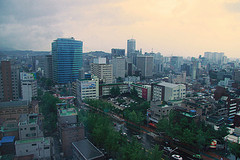
Seoul, by Hyunwoo Sun
Earlier this year, a major report was published by the Economist Intelligence Unit (EIU) that dug into current trends among major cities in Asia.  In the Asian Green City Index, the EIU looked at 22 Asian cities (capitals and other leading business centers) and compared them against each other in key areas of environmental performance. Each city received both an overall ranking and a breakdown of what contributed to their scores in each key area. The following data from one city, Seoul, demonstrates what the study highlights.
The report, sponsored by Siemens, concluded that Seoul ranked “above average” (receiving a score of 4 out of 5), and shares this distinction with Hong Kong, Osaka, Taipei, Tokyo and Yokohama. The city of Singapore was the only city to achieve the score of “well above average.”
Seoul, the third most densely populated city in the study, ranked well in areas of energy and carbon dioxide, transportation, water, land use and buildings, sanitation and environmental governance. Seoul was lauded for having one of the best transportation networks of buses and subways, and for having minimal water leakage problems coupled with one of the highest rates of access to sanitation and wastewater treatment. The City is also at the top of the class (compared to cities with similar income levels) for low carbon dioxide emissions and high energy efficiency.
Seoul Traffic, by JimTheGiantEagle
However, the study revealed that “[Seoul] produces the most waste among all 22 cities in the Index, at an estimated 996 kg per person per year, well above the Index average of 375 kg.” Seoul also only scored “average” on its air quality because of the amount of nitrogen dioxide emissions. “It has the second highest concentration of this pollutant in the Index, at 71 micrograms per cubic metre, compared to the average of 47 micrograms. This is due to Seoul’s over-reliance on cars — automobiles are a main source of nitrogen dioxide — and they are responsible for almost three quarters of Seoul’s air pollution.” Seoul also boasts less green space than the study’s average.
The report highlighted figures from the United Nations and the Asian Development Bank revealing that Asian cities are becoming more concentrated as people migrate to urban centers (over the last five years over 100,000 residents moved to Asian cities every day). Overall, the study sought to determine the environmental strength of these leading cities and offer areas for improvement.

Wednesday, May 18, 2011

City Spotlight: Daegu, South Korea a renewable energy innovator

A version of this article was also published in the City of Daegu's English language newspaper In Daegu.

As the demand, cost and availability of energy continues to rise, cities that invest in clean, green sources of energy are building a sustainable future for themselves and their inhabitants. Last year, South Korea announced its intention to spend 40 trillion Won to support the development of clean and renewable sources of energy between now and 2015. The Korean government wants to become one of the worlds top five clean energy economies. Such a commitment to clean energy greatly benefits many cities in Korea. Here we showcase the City of Daegu in Southeastern Korea. As the third largest city in the country with a population of 2.5 million, Daegu has already made significant strides of its own in the field of renewable and green energy technology.

Daegu promotional poster highlights its
recognition as an ISCI "solar city."

Daegu didnt just jump on the renewable energy bandwagon as soon as it became popular. Rather, the city has had a systematic approach to solar and other sustainable energy sources since the creation, in 2000, of a forward-looking 50-year project plan called Visions for a Sustainable City. Spearheaded by three Professors from Kyungpook National University, this plan aims to:

1) reduce the carbon footprint of Daegus residents
2) develop a renewable energy-based urban community
3) pursue culturally and ecologically sound economic development

Daegu joined the International Solar Cities Initiative in 2003 and, in 2004, hosted the first International Solar Cities Congress.

In April 2011, Solar City Daegu held its 4th annual Green Energy Expo at the EXCO center with international participation almost 400 companies and 40,000 attendees. The Expo showcased a number of initiatives currently underway in Daegu (including the EXCO center itself, whose renovations will produce over 1.1 million kilowatts of electricity from renewable energy sources).

Daesung Energy's model of the
solar power tower.
Lets showcase a few initiatives. In the works since 2008, Koreas first solar power tower project by Daesung Energy will deliver 200 kilowatts of energy via a solar heat concentrating system to the citys grid this fall. This solar power system will be the largest solar energy plant in Korea.

Additionally, Daegu is home to a landfill gas-to-energy facility that, since 2006, has provided the city with 1.5 megawatts of energy per hour. Designated as a UN Kyoto Protocol Clean Development Mechanism, this project prevents over 300,000 tons of carbon dioxide from being released into the atmosphere.
Fiberboard slate is manufactured
from discarded fibers pictured here.

Other exciting innovations were showcased at the Expo that should be implemented in Daegu and in other cities around the world. These include street lights that generate their own power via a small solar panel or wind turbine perched at the top of the pole and car ports fitted with solar power roofs.

Also be on the lookout for an innovative new fiber board slate, made by Hyundai Industrial Trident. While not a source of energy, this innovative process is reusing discarded fibers (trash) from the garment and textile industries in and near Daegu to create non-toxic corrugated roofing material.

Looking ahead, Daegu will be the host city of the 2013 World Energy Congress in October. Until then, the city will continue to implement new and exciting forms of clean, green energy and promote innovative ways to reuse what is otherwise considered trash.